Estimated reading time: 8 minutes
Key Takeaways
- Impulse spending is engineered: one-click checkout, saved cards, and scarcity timers exist to remove the pause where second thoughts happen.
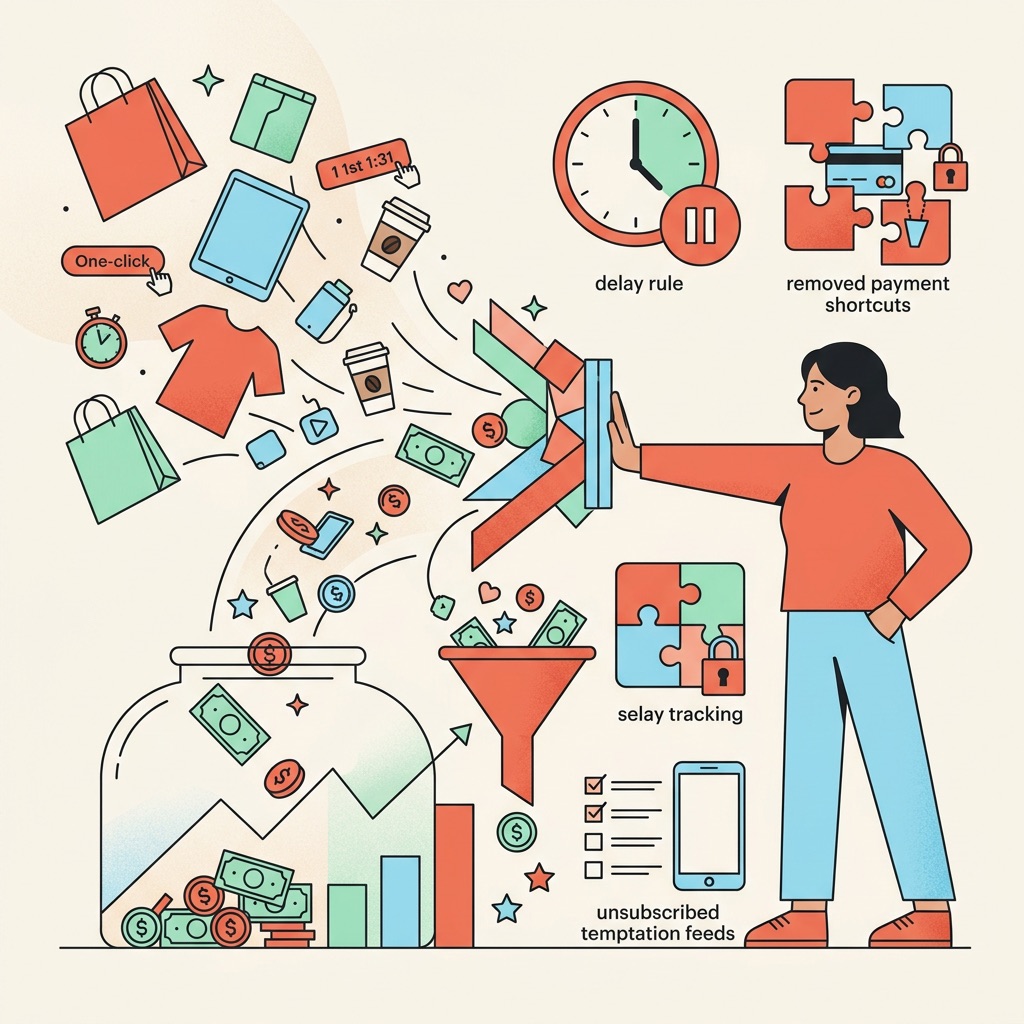
- The most effective countermeasures add friction back: delay rules, removed payment shortcuts, and unsubscribed temptation feeds.
- A dedicated fun-money budget beats total abstinence: deprivation is what turns small slips into blowouts.
- Logging every purchase at the moment it happens is the single strongest habit, because awareness changes behavior before rules do.
- Track your wins: every resisted impulse buy is money you can watch pile up toward a real goal.
Table of Contents
- Why You Impulse Spend (It’s Not Weakness)
- Tactics 1–3: Add Delay
- Tactics 4–6: Add Friction
- Tactics 7–9: Redirect the Impulse
- The Keystone Habit: Log It the Moment You Spend It
- Conclusion
Why You Impulse Spend (It’s Not Weakness)
Somewhere between the product page and the doorstep, billions of dollars a year change hands through purchases nobody planned. That’s not an accident of human weakness; it’s the deliberate output of an industry. One-click checkout, cards saved in every app, “only 3 left” counters, free-shipping thresholds, and algorithmic feeds that learn exactly which sneakers to show you: all of it exists to shorten the distance between want and bought until no reflection fits in between.
Understanding this reframes the problem. You don’t need more willpower. You need to re-insert the pauses that modern retail carefully removed. Every tactic below is a version of that.
Tactics 1–3: Add Delay
- 1. The 72-hour rule. Anything unplanned over a threshold you choose (say $30) goes on a wishlist for three days before you’re allowed to buy it. Most impulses simply expire; the wanting was the dopamine, and it doesn’t survive the wait. Whatever’s still appealing on day three, buy without guilt.
- 2. The one-in-the-cart overnight rule. For online shopping, allow yourself to fill the cart freely, and then close the tab. If you remember the item tomorrow, that’s data. Most carts die overnight, which is exactly why retailers send abandoned-cart discount emails (take the discount if you were buying anyway; recognize the manipulation if you weren’t).
- 3. Cost-per-use math, out loud. Before buying, estimate honest uses: a $90 gadget used twice is $45 a use; a $90 coat worn 100 times is 90 cents. Saying the number out loud recruits the analytical brain that impulse shopping routes around.
Tactics 4–6: Add Friction
- 4. Delete saved cards. Remove your card from browsers, app stores, and shopping apps. Walking to find your wallet is a 40-second pause, and 40 seconds is often all a second thought needs.
- 5. Unsubscribe and unfollow ruthlessly. Marketing emails, deal alerts, and haul-content feeds are impulse triggers you re-arm daily. You can’t buy what you never saw. This tactic alone often does more than every budgeting rule combined.
- 6. Shop with a list and a timer. A list defines success before the store’s layout gets a vote (grocery stores are laid out precisely to defeat this; our grocery budgeting guide goes deeper). A timer adds urgency that competes with browsing.
Tactics 7–9: Redirect the Impulse
- 7. Give yourself a fun-money budget. Total bans backfire: deprivation builds pressure until it blows through your defenses in one big splurge. A dedicated, guilt-free impulse budget ($20, $50, whatever fits) converts “never” into “this much, freely.” The psychology mirrors the allowance rule from our couples budgeting guide: caps create freedom, not restriction.
- 8. Make the alternative visible. Impulse buys win because they’re concrete and the alternative is abstract. Fix the asymmetry: keep a named goal, like the trip or the emergency fund, where you see it daily. Every resisted purchase becomes a transfer to something instead of a denial.
- 9. Log the near-misses. Keep a “didn’t buy it” note: item, price, date. Watching resisted purchases total up ($340 this month) turns self-control from an invisible sacrifice into a visible score you’ll want to protect.
The Keystone Habit: Log It the Moment You Spend It
Every tactic above gets stronger with one underlying habit: recording every purchase at the moment it happens. Not weekly reconciliation: at the register, in the parking lot, before the receipt is in the bag. The act of logging is itself a pause, and the running total it maintains is the honest number that makes tactics 1–9 stick. It’s the same principle behind our guide to tracking discretionary spending: what gets seen gets managed.
This is exactly what Pennies is built for. Logging an expense takes two taps (pick the budget, punch the amount), fast enough to do while the card machine is still printing. Your fun-money budget shows what’s left before you buy, not in a spreadsheet three weeks later, and with the Apple Watch app the pause fits on your wrist. No bank connection, no transaction imports three days late: just the number that matters, when it matters.
Conclusion
Impulse spending shrinks when buying gets slower, temptation gets quieter, and the money you’re protecting gets a face. Pick three tactics (one delay, one friction, one redirect), run them for a month, and let the “didn’t buy it” list prove what they’re worth.
Give your impulses a budget they can live inside: download Pennies, create a fun-money budget, and make the two-tap log your new checkout ritual.
FAQ
Is impulse buying a sign of poor self-control?
Not primarily. Modern checkout flows are engineered to remove the natural pauses where reflection happens. Re-adding delay and friction (waiting periods, deleted saved cards, fewer marketing triggers) works far better than trying to out-muscle systems designed by teams of behavioral experts.
What is the 72-hour rule?
Any unplanned purchase above a threshold you set waits 72 hours on a wishlist before you may buy it. Most urges fade within that window; whatever survives is probably a purchase you’ll actually value.
Should I ban impulse purchases completely?
No. Total bans usually end in blowout splurges. A small dedicated fun-money budget you can spend guilt-free keeps the pressure valve open while capping the damage.
How do I know if my impulse spending is improving?
Track two numbers: your fun-money budget’s balance, and a running list of purchases you considered but skipped. The first shows containment, the second shows momentum, and both should make the progress visible within a month.